
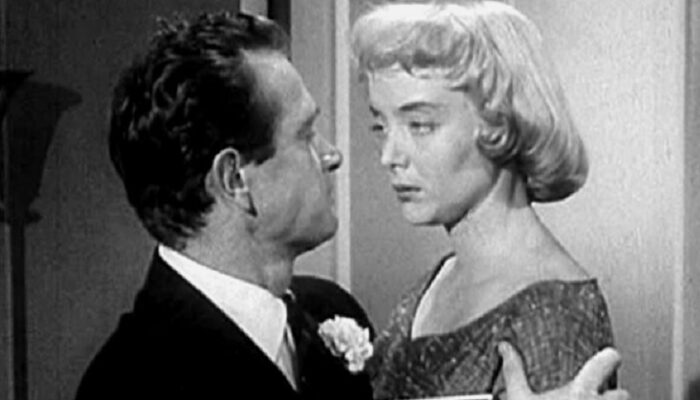
When you look at “The Cheney Vase,” you are getting a beautifully dark masterclass in how pride and greed can completely blind a person. The story kicks off with Lyle Endicott, getting fired from his museum gig. Instead of taking the loss and moving on, he decides to orchestrate a grift against Martha Cheney, a wealthy, wheelchair bound elderly woman who happens to own a priceless ancient artifact. Lyle smoothly manipulates his way into her good graces, gets hired as her guardian, and systematically cuts her off from her loyal staff so he can find and steal the vase. It is a classic setup of a predator picking on what he assumes is an easy target, but Hitchcock, as always, has a much deeper game to play.
Lyle is the ultimate narcissist, treating everyone around him, including his accomplice Pamela, as completely disposable junk. Because he sees Martha solely as a frail, helpless invalid, he underestimates her intellect, which proves to be his undoing. The brilliant twist comes from Martha herself. She is not some clueless victim; she is an artist who possesses real agency. Recognizing Lyle’s malicious intentions, she uses her sculpting skills to forge twenty five exact replicas of the artifact. By the time Lyle tries to make his big move, he is stuck looking at a room full of identical pots, leaving him unable to tell the priceless treasure from the worthless fakes. Martha essentially uses his own greed to trap him in a prison of his own making, while a betrayed Pamela ensures his getaway plans completely fall apart.
The core takeaway from this story boils down to the danger of underestimating people based on surface appearances. Lyle looked at Martha and only saw physical limitations and dollar signs, completely missing the sharp, creative mind operating right in front of him. His arrogance made him sloppy, and his complete lack of respect for the people he manipulated left him isolated when the tables finally turned. It is a fantastic psychological study showing that true strength is about intellect and wit, not physical dominance or smooth talking coercion. For a mid fifties television anthology piece, it holds up incredibly well because that specific flavor of poetic justice never really goes out of style.
